Bitcoin's Security budget in 2026

We are now 17 years into the Bitcoin experiment; The future of 2009 is now, not just 100 years from now. This article is not going to focus on 2140 security budget concerns, rather what could happen in the next 17 years. We will leave the chart showing how exponential decay goes to machine zero by 2140 for the groksloppers. The point of this piece is to argue that there are mining failures possible in the next 10-15 years that are within the set of reasonably likely events.
In 2026 there are three inflective trends that could effect a major phase shift in Bitcoin's security model
1) Expected miner revenue may be peaking and starting a secular trend downward.
2) The surge of money into AI/HPC massively increases the opportunity costs for medium and larger miners who have made investments in electricity infrastructure.
3) As coins have been traded away from OG holders and into the hands of institutions, DATs, SBRs and ETFs, the economic locus of cultural norms and has shifted away from cypherpunk and towards institutional. Similarly mining has gone from neckbeard to quarter-zip.
I argue in the following that this sets up a wide set of paths leading to mining centralization, even in the next 15 years. This comes in two stages, first a period of consolidation, then a short period where dominant miners coordinate - which will be met by a shrug from the market.
To be clear, all of this is in the backdrop of a secular downtrend in mining revenue: I expect this trend will become evident in the next 15 years if it already hasn't started - even if Bitcoin has another 10x in it, the price cannot outrun geometric growth forever - in that case add a decade to the following scenarios.
Expected miner revenue may be peaking and starting a secular trend downward
In 2028 (a little over two years from now) the subsidy will drop to 1.5625. It's 2026 and fee markets have not materialized. Market prices are no longer muzzle velocity; at least from high-water marks, the price did not double this cycle, the low-water marks might be trending upwards (but we don't know yet if we've seen the bottoms.) Jan 1, 2026 will be the first time in history that the price decreased over a post-halving year. Over the last year, Bitcoin appears to have lost luster as a unique hedge against inflation. Whether this is permanent or not is up to the market - but there's a reasonable possibility that it's just another boring asset now.
Miner revenue moving averages since 2016 can be seen in the following chart. There isn't a slam-dunk takeaway but it's certainly feasible that the green curve is at leveling off.
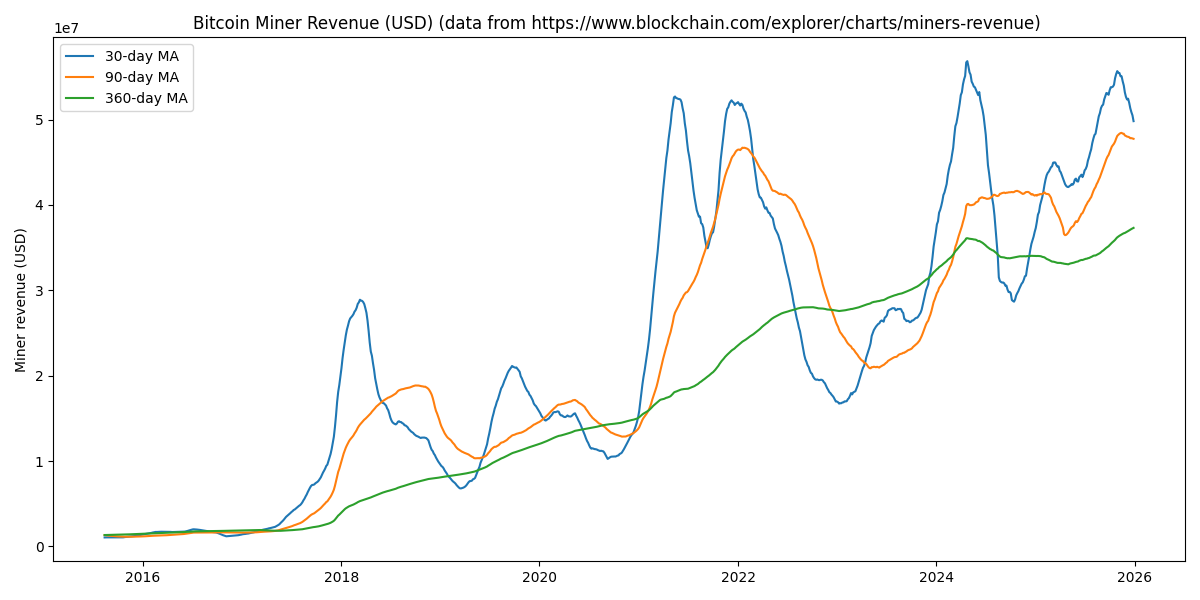
This is important; Miner revenue is a pie that must be shared among miners. As long as the pie was growing over time miners who ran efficient businesses could expect to remain profitable. Once this pie starts to shrink, profits will compress rapidly.
Over time investment has lagged behind the payout. Once the payout slows down and investment catches up, it's a different regime.
The surge of money into AI/HPC massively increases the opportunity costs for miners who have made investments in electricity.
This trend is well-reported and clear if you've been paying attention. Many of the larger publicly-traded Bitcoin miners have pivoted to AI/HPC. Large tech firms like Google, Meta and Microsoft have been acquiring stake in many of these companies. Mining stocks have had huge 2025s despite disappointing Bitcoin returns.
This is not just footsy-flirting with a new revenue steams, some miners have declared they are done investing in mining completely. Activists investors have aggressively pushed pivots to AI. This is a major shift in the economics keeping most of these businesses operating.
The thing is about this trend is that (while of course AI could be a bubble, we have no idea where we are in that cycle) AI/HPC has no difficulty adjustment, no upside limit, and no halving; so the revenue available to data centers providing HPC is going to keep trending upward secularly for a long time, perhaps forever, while the revenue to those doing mining is going to trend down. AI data center money comes from the money printers, and the money printers don't ship with an off button.
The real question is how far down the curve this affects behavior. I make no claims I know how exactly this is going to play out. The key unknown here is the behavior of the long tail of smaller miners. We will come back to the topic of consolidation, but for now, to waylay concerns about centralization, it would suffice to argue that AI/HPC would come only for the bigger miners, leaving the Bitcoin actually more decentralized.
Steve Barbour, Margot Paez and Rob Warren and others have made the argument (and a solid one, as it's supported by empirical evidence) that there will continue be a somewhat fat tail of smallish miners that are too small or too reliant on intermittent energy sources to do the pivot to AI. These miners will continue to ferret out good sources of energy which will always making reinvesting in mining worth their while.
To counter this, I would say that what we are seeing is that Big Tech is coming after the biggest targets first. Google is going to take stake in Cipher and Terawolf before coming after the smaller miners you've never heard of. We're just getting started with this whole AI takeover thing.
Setting up an AI data center is certainly more complicated than plugging in miners. Someone sitting on 10 MW of power might still be in this decision zone. If we continue to see an environment with sloshy AI money where electricity is in high demand, one could imagine an entire subsector of private equity going around promising smaller miners massive profits for selling or converting their operations. One can run a data center with as little as 5-10 MW : the pivot could be tempting for a large spectrum of miners.
Certainly there are some miners who are not going to have the opportunity to pivot because they don't have the setup that AI/HPC demands. What I don't know is whether or not this is 0.3%, 3% or 30% of the hashrate.
The culture has shifted. Bitcoin is too big to fail.
This is something I've been hobby-horsing for a while now. Bitcoin's original security model was based on the idea that centralization was the ultimate failure. OG Bitcoiners would have seen mining centralization as a abysmal failure of the entire project and moved on to other things with their lives. This certainty-of-failure scared off any miner who aspired to try things like selfish mining. But now there are 100s of billions of USD worth of bitcoin in corporate hands that do not care about these same values, and won't sell because of something like miner centralization.
After all, the monopoly miner would never do something stupid that would ruin their lucrative position monopoly mining Bitcoin, because that would kill their goose. Game Theory, Right?
The Market Fragility Hypothesis no longer holds: Bitcoin will not immediately sell off in response to a failure of mining decentralization. No mining cabal would dare mess with 21 million - so a takeover doesn't affect scarcity. Michael Saylor wouldn't even acknowledge the takeover.
2010 era threat heuristics need to be discarded
Again, we're in the future now and the main use case of Bitcoin is not for the Silk Road. The threat model needs to be updated.
We're certainly not worried about some rogue villain sneaking in a $5 Billion double-spend. None of this is realistic considering the size of the industry and the players, who are no longer internet anons dealing with small scale drug transactions. Good luck finding someone who will give you something valuable in exchange for 50000 bitcoins without knowing exactly who you are and where you live. You might as well walk into Walmart and ask if they will cash a $3 million check.
Neither are we worried about rogue attackers wreaking havoc and causing a failure of consensus. The Government is not going to get very angry that we've tunneled through their panopticon and come full force at Bitcoin to shut it down. We know by know that Bitcoin functions more often than not as part of the panopticon.
The main threat, the only threat, from 2017 and into the future is non-destructive centralization.
At the end of the day, the worst that a rogue attacker could do is force centralization. While this tarnishes the aesthetic a bit, most Bitcoiners would prefer a functioning Bitcoin which acts as a store of value to something which is worthless. Centralization is an incredibly easy softfork; all it requires is miners signing the coinbase transaction from a whitelisted set of keys. (This softfork would be easy to reverse without a hardfork; especially with covenants or introspection in coinbase txs.)
Stage 1: Consolidation
If expected mining revenue is predicted to not meet the amount of investment chasing it, miners will face decisions. Hashprices are consistently falling, (see the ugly chart below) but the availability of more efficient machines is increasing: Miners from hobbyist all the way up to public corporation have to make a decision; should we invest in expensive new equipment to get ahead of the falling hashprice, or not? If you're a home miner, you have no penalty for just turning off the s21. If you're a large pubco with energy infrastructure you're giving up large upside by not pivoting to AI.
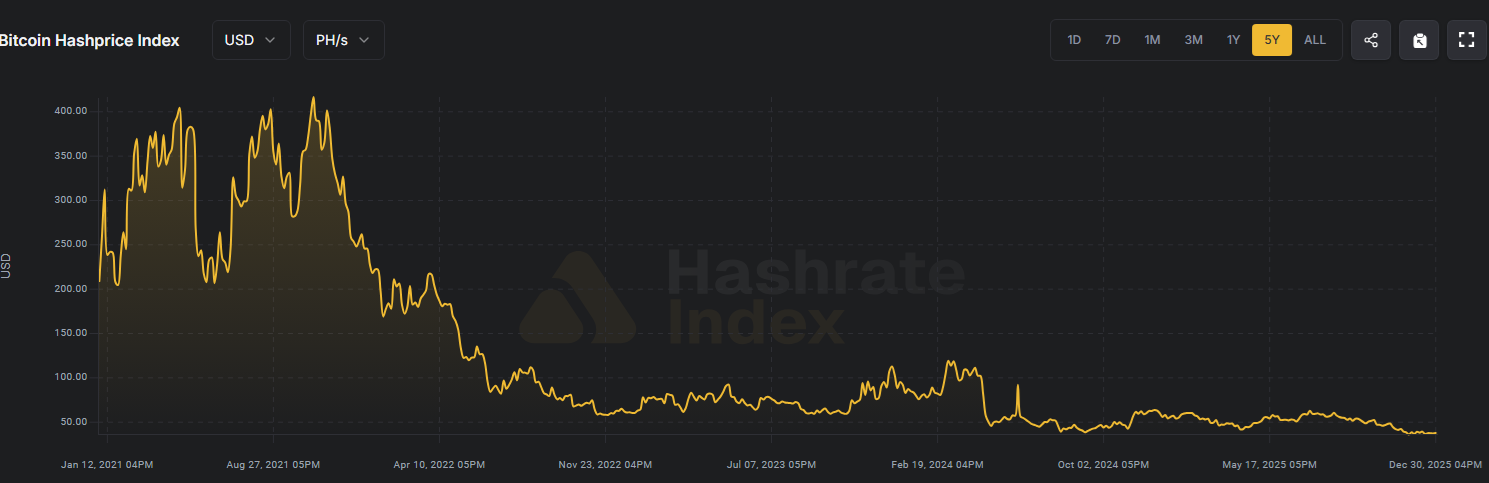
The danger scenario is the following: Miners follow a K-shaped response to cratering hashprice: Most miners let their profits whither away and don't come back, while a few move forward aggressively, seeking out the most efficient machines and greater market share. In a relatively short period (say 12-18 months) this could result in a few players having a large portion of hashrate.
Just to give numbers, today we are around 1100 EH - we ended 2024 at about 800 EH. Now imagine that hashrate continues to grow at the same rate (say adding 350 EH over a year) but this is dominated by a sort of power law: 20% of today's ownership (today 220 EH) acquires 80% of the new hashrate being added. If we assume that say, 25% of hashrate goes offline (losing 275 EH), the 20% will collectively add 625 EH - now this 20% has grown to about 845 EH out of 1500 total, solidly over 50% of the total hashrate.
Do your own math, pick your own number; these are just arbitrary guesses seeding one path. Generally speaking it's mathematically clear that if a smaller group moves aggressively forward while other groups pivot or drop out, there result is massive shift in the distribution of the hashrate, especially if this pattern is repeated over time.
Hashrate continues to march forward: See the logchart below. Even if some groups peel away, one would expect the hash to continue to grow.
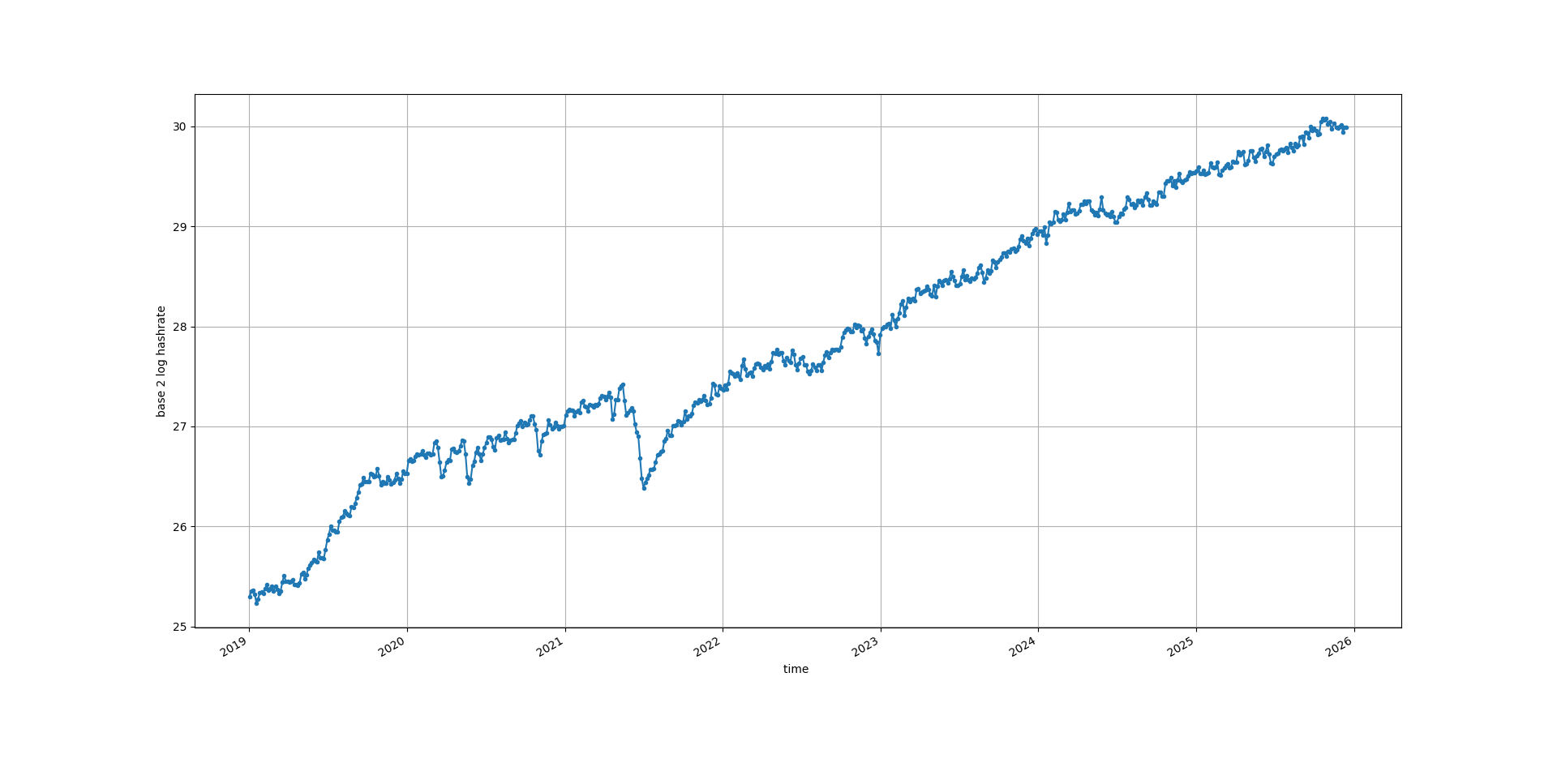
It's certainly economic for any miner with over a GW in their control to be strongly tempted to pivot - we've seen that over the last year But this is not required; a miner may elect not to pivot and double down on pureplay. They would have access to the machines that are rolling out over the next year or two which could replace most of the hashrate, especially if the shrinking pie forces the less efficient machines out of the game.
The important thing to note about the hashrate curve is how frequently it doubles (the above chart is log 2: each horizontal line is doubling.) Just to labor obvious math: each time it doubles, this means that the amount of hashrate added since the last time it doubled is at least the hash that was available at that time. So if the hash rate doubles by 2028; most of the decisions (modulo some lag) about where a majority of the hashrate will be in 2028 will take place after today.
This discussion so far is based on simply comparison with AI economics. Also in play (not certain, but absolutely in play) is the historical bear market consolidation crunch in which miners spend the year or two following the cycle top in a lot of pain. This would be expected to result in bankruptcy or consolidation - accelerating any K-shaped trends.
In short: AI acceleration+ typical cyclical Bitcoin bear market, and we could have a massive consolidation of hashrate, even by mid 2027.
Mid 2027 is aggressive, the same dynamics could play out over 5-10 years as well.
Stage 2: Coordination
Now assume consolidation has happened. Miners have responded to shrinking pie in a K-shaped fashion. As a result there are a few miners who control a large chunk of the hashrate.
Continuing to assume we are in a backdrop of dwindling rewards to miners, profits are compressed, and could be net-negative if capital investment was too aggressive. The competition will become more fierce. It will make sense for the larger miners to act aggressively to accelerate the attrition: perhaps this means continuing to run machines that are barely profitable. This could mean reaching out to struggling competitors offering cash for their business. Another technique they can use is private mempools or out-of-band payments (the reasons why these could develop are fascinating and varied, we'll leave this as an unknown here). One simple reason for private mempools is so that regular blockspace users could lock in long-term contracts with miners at fixed or discounted rates. There's no reason large pubco miners trying to grab market share in a competitive industry wouldn't using traditional branding techniques like rewards points, or brand ambassadors like Marshawn Lynch. They could develop their own wallet app which defaults to private mempools.
Sooner or later, there will be a few at the top duking it out, with a tail of stubborn smaller miners around the periphery.
Then one of them will float the idea of selfish mining. (Selfish mining is a technique where a miner with 1/3 of the hashrate can selectively withhold blocks in a way that disproportionately hurts other miners, leading to larger return on hashrate than other miners. )
Once the conversation starts, the whole thing goes quickly like a stick of butter in the microwave. The instant the topic is broached, every miner realizes that any coalition of 33% or larger could possibly form a selfish mining cabal. Naturally, they want to be in the cabal and not outside of the cabal; they negotiate swiftly to form such a cabal.
This is a classic coalitional game theory problem. The coordinated solution becomes expected when it becomes clear that the system will not be completely destroyed by coordination (and it won't as it's no longer 2013.)
Note that there's nothing the plebs can do here. The institutions will not care at all.
The plebs face a decision, whether to sell or not. Once selfish mining starts blocks may be a bit choppy, but if you're using a selfish miner in the cabal ("Good News Riot Rewards Members; We're teaming up with Tap That Hash so you can now use your Riot Rewards Points at 1500 more partner restaurants!") you should experience no uncertainties with your transactions.
The institution also face the same decision, but there's no reason at all to sell. That would make them look foolish, especially as this threat should have been seen on the horizon for a while. Rationalization will abound.
The snowball period between selfish mining and monopoly mining will be short and sweet as smaller miners fall away to attrition. Once monopoly mining begins, the cabal eases down the hashrate, negotiating a non-competitive arrangement.
And obviously, the antitrust folks at the USG would spend all of 10 minutes considering such a merger. Corporate control over the Bitcoin blockchain means no more rogue miners processing OFAC transactions. That's an easy one.
Main assumptions
The above scenario is somewhat broad. It requires the following things
- Secular dwindling of miner revenues
- K-shaped response by miners to decrease in revenues
- Aggressive pursuit of market share by struggling miners
- Willingness to coordinate to selfism mine to recover profits by the 33% of miners.
That's it. I'm not saying this is going to happen for sure by 2040, I'm pointing out that the path is not vanishingly narrow.
Just to be more specific and slightly provocative: I'll suggest possible actors who could pull this off.
Bitmain could do it. They are keeping their spot at the fabs and churning out increasingly efficient chips. It they can't dump these chips into a saturated market, they keep them. This leads to a scenario where they just build up their own mining game. If the ASICs market is depressed for a year or two, Bitmain may wake-up one day with 40% of the hashrate and just go for it.
Eric Trump /Hut 8 could do it. Trump says a lot of ignorable things, what if "All Bitcoins should be made in the USA" turns out to be not one of them? There's some fun conspiratorial scenarios in which American Bitcoin is the pureplay player who moves forward while other miners are jumping ship, assisted by tariff exemptions and scrutiny on competitors.
Nydig could do it. I have no real meat to this theory, they're just a private miner with a history of strong moves.