Prediction markets aren't really "truth telling machines"


There's a lot of excitement about prediction markets, a lot of weird boosterism in which folks are calling these "truth-telling machines."
To begin, I have a small rant on the idea of a truth-telling machine
The idea of a "truth telling machine" has long been one of the most obnoxious brainworms of folks in crypto and other emerging tech – generally speaking if you build a Rube-Goldberg machine and are able to tease out some information that might be accurate; you get to call that a truth telling machine.
To reduce to a dumb example: A banana is truth-telling machine because if you hold the banana in the air, and then drop it, it goes the direction of gravity. Almost 100% of the time. It will not lie. So if you want to know which way gravity is pointing - USE A BANANA. A BANANA IS A TRUTH TELLING MACHINE.
Blockchain are like that; You can't lie about hashes or validity of signatures. But that rarely means anything outside of the realm of the actual blockchain. Timestamping is a "truth-case" but how often have you actually need to time-stamp something and a blockchain was your best option?
Prediction markets are interesting, but there's some paradoxical behaviors. I bin them into a thee categories
I) Gambling on events where the information is publicly known. The "truth" here is a number generated by an ensemble of different actuarial models, weighted by money as a proxy for confidence.
II) Events where insiders know information we don't - the "truth" generated by these markets is precisely the inside information is leaked into the public domain.
III) Events in which there is not a static latent probability space we're betting on, but one that can be changed by financial incentives presented by the market itself. Assassination/arson markets, etc.
There's narrow ways these can intersect: typically a sporting event is type I – but there could be situations in which a player knows they are injured or may be motivated to throw a game. National security questions "will we bomb Cuba?" are type II, pessimistically type III.
My claim is that the usefulness of these in type I is limited; only in a few narrow use cases is the information good and actionable. The biggest truth-case is type II, which happens to be illegal and expressly forbidden by the CFTC. (As is type III.)
If you've ever done any sort of machine learning, you're aware of the "ensemble" model. You throw every model you can at a problem, and then take some sort of weighted average. Ensemble models tend to be pretty good, but this isn't a universal law, it's just that more often that not, the more models you throw at something the more likely the average is going to approximate the truth.
That's all that's happening with Type I. If the Seahawks have the ball at their own 17 yard line down by two points with 2:43 left and both teams 2 timeouts; Everybody has a different model of how to simulate the rest of the game. Average them out and you have a real time probability on the outcome. This type I case is fun, and interesting– a good test of someone's predictive model chops, but is this some sort of useful actionable truth? Maybe. Who's to say.
A more useful model would be weather prediction: Will there be a hurricane in Rhode Island on August 27 of this year? Weather is notoriously hard to predict, so if someone develops a model that can put a number that deviates from say historical averages - that's good, that' a useful truth-case. I would like to see this.
Another place where type I is legit useful is when people in the public discourse are committed to stupid beliefs about reality. It's nice to have a number to shove in their face: If the market has finite expiry (most do) it solves the Keynes "Market Can Stay Irrational" problem. While hopium huffing TSLA permabulls can deep doubling down on long after Elon's nonsense promises don't materialize, they can't outlast a contract with finite expiry.
So if Elon promises 10 million robotaxis by 2028, and you say "he's full of shit" and people say "WHY don't you SHORT the STOCK?" now you can say "no thanks, I will participate a futures market that expires in 2028" and slowly drain liquidity out of hopium addicts. You won't get squeezed in such a market products (unless you're taking loans to cover "yes" future you sell) . Just buy the no futures and sell what "yes" futures you can cover and wait for the payout.
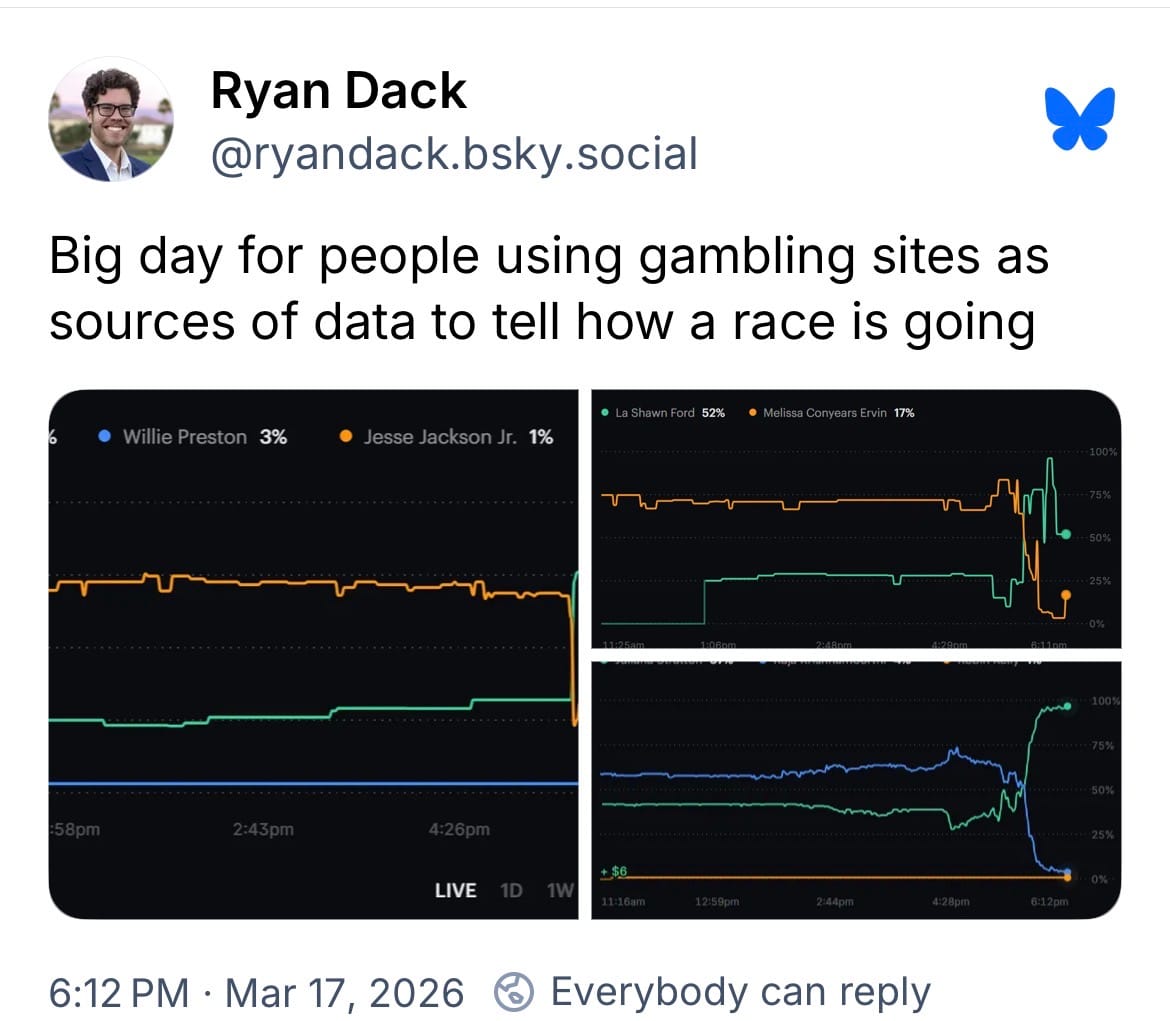
I'm going to go ahead and claim that the political prediction markets aren't useful. At best, prediction markets tabulate incoming results faster than the New York Times political desk on election night. But is that useful? It mean you can refresh your app 127 times an hour on election night to see the number move, but other than flaming off that angry email to your extended family, how actionable is that information?
Before an election, prediction markets provide no useful information. They are type I. We are all just looking at polls. Nate Silver has his predictions, Sam Wang has his, everyone's got their own. Prediction market is just a weighted average, an ensemble. There is no more "truth" to this.
If they converge faster on election night; it could be because they're essentially tabulating faster – or– it could also mean that they are under-indexing a long-tail bias – you wouldn't be able to determine that they're NOT doing this unless you saw 100s of independent elections. Different states breaking the same way on the same election night can just be evidence of the same bias.
Just to reiterate this: people who point to one election and say they are "more accurate" don't understand math or statistics. The evidence is not there. Sometimes they are wrong. As more independent elections occur, more will be wrong.
Type II and Type III were actual the reason these were dreamt up decades ago. The truth-telling factor is the ability of some insider to leak information. An insider could out corruption using a prediction market. The fact that someone could be inspired to murder a corrupt official, even better, according to the early cypherpunks. Early prediction market enthusiasts imagined that assassination markets would be used by the good guys against the baddies who violate the non-aggression principle. Technologists of all ages seem to have this same lack of imagination: Certainly this tool that allows me to do this neat thing at scale will only be used for prosocial use cases, right? (cue Anakin-Padme meme)
But this is the world we live in some folks are always excited for the good use cases and don't always think what will come 4,7, or 13 years later.
Concerns
Some of these are social/normative concerns and economic/technical/game theory concerns, some are a mix of both.
1) Goodhart's Law. Any metric becomes a target. This is a metric that is buyable on the open market at a price.
Obviously, some targets are valuable. Trump sued a pollster who underestimated his performance. Why would he do that? Obviously there is some economic value in the polls.
2) Market themselves have become subject to secondary markets. So the number you're seeing might not be "true"; it might reflect a skewed landscape were Jane Streets of the world are doing who-knows-what.
3)If the expiry is far enough out, you may or may not be able to avoid memecoin economics.
4)Hedge funds may try to flip stupid ideas. Why not seek out unpopular ideas that you think you can sell at a higher price - even if you're not going to hold the futures asset until expiry? The nihilism starts to become clear - if someone is convincing you of some idea, you have no idea if they're just suddenly really interested in some species of fish going extinct or if they're trying to pump bags.
5)Because these are instant gratification, clickable, refreshable, 24-7, they will be preferred by consumers, they will replace more wholesome sources. Every click online is counted. If a newspaper sees these are getting the clicks, they're going to lessen investment in traditional analysis and information gathering. Journalism will lay of pollsters and analysts and contract with Kalshi.
Our brains in search of novel information will become dull, less able to process analysis. Smart people who do analysis and research, instead of operating in the public square, will be employed by hedge funds.
6) Billionaires or moneyed interests will be able to buy the field of candidates for almost any election. (Back to Goodhart's law) Markets for any election will form early (aren't you curious who's going to run in your district in 2028?). The early front-runner will get the coverage and the notoriety, sometimes for no good reason other than they have deep-pocketed backers.
At this point Poker dynamics kick in, and bets become self-fulfilling
7)People can become personally invested in bad ideas, creating some icky conflict of interests. We've already seen markets on whether a nuke will go off or if America will go into a civil war. There's a lot of other bad things that can happen that contrarians can start arguing are inevitable and maybe these are good, actually. We know incentives can cook people's brains. Inching something once unheard of into the Overton window could happen.
8)Massive culture wars all over again about moderation/who decides. The framing, where on the page it's listed, to whom the market is shown (shadowbanning!!) these are all decisions that are going to really set the usual suspects off. Consider Wikipedia, which is 99.99% true facts, and some people want to destroy it. These folks will not go away.
9) Smaller markets with less information will be leveraged against larger markets. Again this is Goodhart's law. There could be a smaller market betting on quantum computing. A sudden spike in one of these markets could cause Bitcoin to sell off. If you can short $100 million in Bitcoin and cause a spike in the quantum market for $20k, you might have a good payoff.
10)Arson/assassination/infection markets. Many bad outcomes are causable by humans. On centralized platforms, these might be avoided. If these are true crypto markets, there's nothing we can do.
11) Questions are wrappers for conspiracy theories or defamation. I can accuse someone of a crime or a cover up, by simply asking the question if it happened, and bet money on it. As the number goes up this thing they did starts to seem feasible. If my goal is to tarnish someone's reputation or give some credibility or pretense to a conspiracy theory, mission accomplished.
(Note that whistleblowing is a pro-social use case, if it's based on truth - but how do you know the difference between a whistleblower and a defamationist)